Product decisions now have real infra price tags
AI-heavy features, real-time analytics, and always-on integrations are expensive to run at scale. Without visibility into the ongoing cost per feature, product teams make investment decisions based on adoption metrics alone — and discover the margin impact later, usually in a finance meeting.
This guide shows product leaders how to make cost-aware design decisions without becoming infrastructure experts. The goal is not to second-guess engineering on every resource choice — it is to ensure that cost is a first-class input in feature design, packaging, and roadmap prioritization from the start.
Understand your features' unit costs
Before you can design cost-aware features, you need to know what existing features cost. Work with engineering and FinOps to get a simple view — ballpark figures are enough to spot outliers and guide priorities. You are not auditing the cloud bill; you are developing a cost intuition for your product.
Dashboards, bulk exports, AI assistants, notification pipelines — what does each actually cost to run?
Broken down by major product area, not just the total product average
Revenue-critical flows such as checkout, booking, or order creation where per-unit cost affects margin directly
Categorize features by value vs cost
Once you have unit cost data, you can place features on a simple 2×2 grid. This gives you a shared language to talk about features with finance and engineering — not "this is cool," but "this delivers high value at low unit cost" or "this is expensive relative to what users get from it."
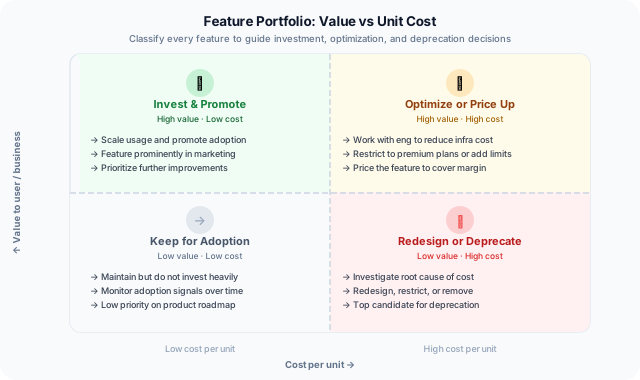
Run this analysis quarterly. Features move between quadrants as usage patterns, architectures, and business priorities evolve.
The most actionable quadrant is the bottom-right: high cost, low value. These features are strong candidates for redesign, restriction to smaller audiences, or removal. Engineering time spent eliminating them often yields more margin than equivalent optimization work on healthy features.
Design cost-aware AI features
AI features are especially prone to cost surprises because token costs scale directly with usage volume and prompt complexity. The design decisions that control AI cost belong in specs and PRDs — not bolted on after launch when the first large invoice arrives.
Choose where AI truly adds value
Identify the moments where an LLM's generative output beats a simpler heuristic or rules-based approach. Don't use AI where it adds cost without differentiation.
Define limits upfront
Number of AI calls per user per period, maximum token depth for prompts, response length caps — these belong in the PRD, not bolted on after launch.
Design feature tiers
Unlimited AI usage for enterprise plans, caps on mid-tier, restricted on free — structured before engineering starts so limits are first-class features, not hacks.
Align model choice with value tier
Work with engineering to match model quality and provider to what the feature actually needs. Don't default to the most capable model for every use case.
AI feature limits — token caps, call frequency, response depth — should be first-class features that product owns, not engineering constraints added after the fact. Define them in the brief so they are designed for, not retrofitted.
Build cost signals into product analytics
Product analytics should capture not only what users do, but what it costs. Without this overlay, PMs are making investment and prioritization decisions with half the information — adoption metrics without the margin context that makes them meaningful.
Usage volume
Events, API calls, and time spent per feature — what users are actually doing
Unit cost
Associated cloud and AI cost per event or interaction — what the usage is costing
Business proxy
Retention, upsell, NPS, or revenue contribution — what the feature is returning
Overlay these three metrics in product dashboards so PMs can see value-vs-cost trends and make data-backed decisions about where to double down or cut back. The goal is a single view per feature: what users are doing, what it's costing, and what the business is getting in return.
Collaborate with engineering on cost-saving UX patterns
Many cost optimizations are UX-driven, not just infrastructure-driven. Product leaders who understand which UX choices are expensive can co-design alternatives that preserve user value while reducing how often or how heavily the system hits expensive resources.
Batch operations
Let users select and act on many items at once instead of triggering per-item API calls or AI requests individually.
Off-peak scheduling
Offer to run heavy tasks (exports, reports, bulk AI processing) at scheduled times rather than immediately, enabling infrastructure to use cheaper capacity.
Pagination and summaries
Use pagination, data sampling, or AI-generated summaries instead of always streaming full datasets — preserves the experience while reducing compute.
"Quick mode" vs "deep mode"
Give users a fast, lower-cost option and a slower, richer option in AI features. Transparent trade-off — users choose based on their need.
These patterns are most effective when introduced at the design stage — not as performance fixes post-launch. A "quick mode vs deep mode" toggle in an AI feature, for example, is a product feature when designed from the start and a hack when added after users have already formed expectations.
Make cost-aware roadmapping a habit
The final step is shifting from cost awareness as a reactive exercise to cost awareness as a built-in part of how your product team works. This means adding cost fields to feature proposals so that cost impact is considered at the brief stage, not the invoice stage.
Estimated infra cost per unit (per user, per call, per transaction)
Whether the feature creates variable cost that scales with usage volume
Which tier or plan the feature belongs to, and whether limits are needed
Which cost pool or engineering team owns the ongoing operational cost
In product reviews
Review unit cost and cost trends alongside adoption and satisfaction metrics — same cadence, same stakeholders, same level of scrutiny.
With FinOps
Coordinate with FinOps so major launches and experiments are reflected in forecasts — preventing cost surprises from releases that land mid-quarter.
The product leader takeaway
Cost-aware product design is not about slowing down feature development or adding finance approval gates to every PRD. It is about having the unit cost data available when design decisions are being made, so the trade-offs are explicit rather than discovered later.
The shift from "build first, worry about cost later" to "design for value and economics from the start" does not require new processes — it requires cost data in the same places where product decisions already happen: the feature brief, the product review, and the roadmap.
Written by
Dileep KK, MonitorGiant
LinkedIn21+ years in IT infrastructure management and observability. Built monitoring dashboards, custom alerting pipelines, and AI token-tracking systems across cloud platforms — AWS, GCP, and Azure — and for organisations spanning defence IT, IoT manufacturing, digital marketing, SaaS email, insurance broking, parliamentary digital services, and educational ERP. Active directory, SIEM, WAF, Cloudflare, MSSQL, Linux, Windows, Entra ID — operated at every layer of the stack.