Why you shouldn't prototype every idea on GPT-4
Early-stage AI experimentation is noisy by design: lots of prompts, revisions, and dead-end ideas. Paying full enterprise rates for that phase is the cloud equivalent of running your unit tests against a production database — it works, but the cost profile makes no sense.
By contrast, running open-weight models locally using tools like Ollama lets your teams explore ideas with near-zero marginal cost after hardware is in place. The strategy is simple:
Approved self-hosted or open-source models on developer laptops or on-prem GPU servers. Near-zero marginal cost. Data stays inside your perimeter.
Benchmark against premium APIs only after the idea is validated. Migrate high-value, revenue-critical flows selectively — with documented justification.
Why local LLMs matter for cost control
Local LLM runners like Ollama, LM Studio, GPT4All, and LocalAI make it straightforward to run capable models on commodity hardware without per-token or per-request charges. For CFOs, this means moving AI R&D back into a capex-like model for hardware instead of uncontrolled opex spread across multiple SaaS AI providers.
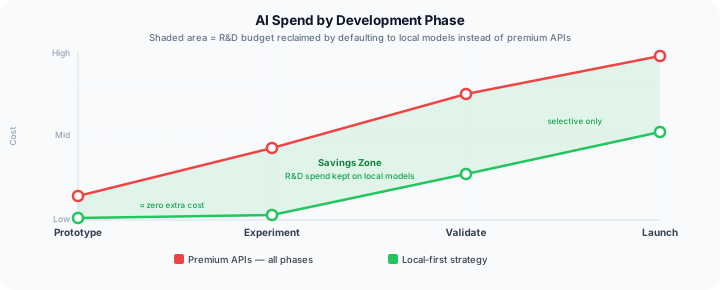
The shaded area is R&D budget reclaimed by defaulting to local models — the savings widen significantly during the experiment and validate phases where iteration is heaviest.
Zero ongoing API cost for experiments
Once the laptop or GPU box is in place, iterative prompting and prototyping are effectively free — no per-token charges.
Predictable spend
Variable token invoices become predictable hardware amortisation and electricity costs — a much easier number to model.
Data privacy by default
Source code, internal documents, and customer data don't leave your network unless you explicitly push them to an external API.
Low latency for interactive work
Developers get fast responses on their own machine or LAN without round trips to external APIs — faster iteration cycles.
What Ollama is and where it fits
Ollama is an open-source tool that lets you download, manage, and run large language models
locally via a simple CLI and REST API. It works on macOS, Windows, and Linux, supports a
broad catalog of open-weight models — Llama, Mistral, Gemma, Qwen, DeepSeek, and more —
and exposes a local HTTP API at http://localhost:11434 that
your applications or IDE extensions can call directly.
Phase 1 — R&D (Ollama)
Local environments and on-prem dev servers. All experiments, prompt engineering, RAG prototyping, and feature exploration happens here. Near-zero marginal cost.
Phase 2 — Production (selective)
Production-grade open-source serving (vLLM, Triton) or migration of specific validated flows to premium managed APIs — only once clearly justified by business value.
Hardware options: from developer laptops to shared GPU boxes
You don't need data-center GPUs to get value from local LLMs for R&D. The right hardware depends on your team size and the size of models you need to run.
Developer Laptops
Best suited for
Coding assistance, prompt engineering, early UX prototyping, RAG over local docs and codebases
3B–8B parameter models (quantized) run well with this setup
Shared On-Prem GPU Box
Best suited for
Multi-user teams, heavier models, multi-modal experiments, shared internal AI sandbox
13B–70B parameter models; developers point tools to internal endpoint (e.g. llm-dev.internal)
From a CFO's perspective, a shared GPU box is a capitalised asset that supports countless experiments at stable cost — instead of thousands of incremental API bills accumulating across every developer on the team.
Recommended local LLM stack (May 2026)
A pragmatic stack for cost-conscious R&D uses free, open-weight tooling throughout. Costs are limited to hardware and power — making this a genuine "R&D sandbox" with no per-experiment billing.
| Component | Tool | Why this choice |
|---|---|---|
| CLI runner | Ollama | Default local HTTP API on port 11434 — one-line model pull and run |
| General / reasoning | Llama 3/4 8B, DeepSeek variants | Strong general-purpose capability, quantized for local hardware |
| Coding | Qwen Coder, DeepSeek Coder | Purpose-built coding models with strong benchmark performance |
| Lightweight chat | Gemma 1B–3B | Low-resource laptops or rapid iteration scenarios |
| IDE integration | VS Code + Continue | Configured to call local Ollama endpoint by default, not cloud APIs |
| GUI front-end | LM Studio / GPT4All | For non-developer stakeholders to test prompts locally without CLI |
A policy template CTOs and CFOs can enforce
Formalising the two-phase strategy as a simple policy gives both engineering and finance a clear rulebook. This is enforceable, not aspirational — it defines the default and the gate to change it.
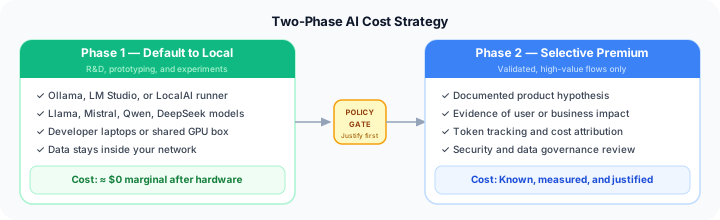
The policy gate is the key control: teams must document a product hypothesis, early evidence of impact, and a cost estimate before accessing premium APIs.
All new AI experiments start on approved local LLM tools (Ollama or the designated on-prem runner). Use approved open-weight models unless there is a documented reason to test proprietary APIs.
Teams must justify moving an experiment to premium APIs with: a clear product hypothesis, early evidence of user or business impact, and an estimated incremental cost vs local models.
Sensitive data stays on-prem and local by default. Any use of external AI APIs must pass a security and data protection review before the first API key is issued.
For premium APIs, usage — tokens, calls, and spend — must be tracked at feature and team level via tagging and FinOps practices from day one.
Implementation blueprint: what to ask your engineering team
Here is a concrete sequence to share with your Head of Engineering or Platform team. Each step is actionable without requiring new budget approvals.
Standardise the local tooling
Configure IDE and tool integrations
Set up shared on-prem AI dev boxes
Add monitoring for governance (not billing)
When (and how) to migrate from local to premium models
Self-hosted LLMs are excellent for idea validation, but there are clear cases where premium APIs earn their place. The discipline is making these decisions explicitly — with data — rather than defaulting to the premium provider because it's easier.
State-of-the-art output quality is required and open models fall measurably short for your specific task.
Enterprise support, SLAs, and global scaling are needed beyond what a small on-prem setup can provide.
Vendor-specific features (advanced function calling, managed guardrails, vector stores) are required.
The feature is validated, revenue-critical, and the incremental cost is justified against incremental value.
Migration decision framework
The CFO and CTO takeaway: default local, escalate premium
A cost-sane AI strategy in 2026 starts with a clear default: local, open-source models for R&D to eliminate runaway token bills and keep sensitive data inside your perimeter. Invest once in the right hardware — developer-grade laptops and a small GPU lab — and treat it as shared infrastructure for innovation.
Use FinOps practices to track when and where premium cloud models are actually needed. Make premium APIs a conscious, gated decision — not the path of least resistance. Teams that experiment aggressively with AI without signing blank checks to every model vendor are the ones that can scale AI investment confidently and sustainably.
Written by
Dileep KK, MonitorGiant
LinkedIn21+ years in IT infrastructure management and observability. Built monitoring dashboards, custom alerting pipelines, and AI token-tracking systems across cloud platforms — AWS, GCP, and Azure — and for organisations spanning defence IT, IoT manufacturing, digital marketing, SaaS email, insurance broking, parliamentary digital services, and educational ERP. Active directory, SIEM, WAF, Cloudflare, MSSQL, Linux, Windows, Entra ID — operated at every layer of the stack.